
Wells, including St. Buonia’s, Slab Shrines and Cill Rialaig - but no Skellig Michael
Unlike Skellig Michael, St. Finan’s Bay has a lovely natural harbour. There is a sandy beach, a place to pull up boats and a fresh water stream with a grate covered with Catholic relics. Although Ireland receives a great deal of rain — between 750 and 3000 mm every year depending on location — and has sixteen significant rivers, it remains an island surrounded by saltwater. Fresh water from a coastal well could easily have been a godsend to a parched sea traveller. Even the native Irish travelled extensively by sea, from one headland to the next, to avoid Ireland’s densely wooded, boggy interior.
Ireland has over three thousand wells, many with an impressive list of healing properties: wells for eye cures, headaches, mental illness, toothache, fever, sore throat, leprosy, skin ailments, diabetes, sore feet and “female troubles”, all with their own patron saint and associated rituals. I tried the weak eyes cure on a previous visit, hoping my belief would outweigh my skepticism, but it didn’t.
Brightening up at my interest, Ryan drives to St. Buonia’s Well (also spelled St Buaine) a few miles down the road. Now known as Kilaboona Oratory — a good illustration of how names change over the millennia — this early Christian site dates back to approximately to the sixth century. “The Priest’s Grave” is what interests me here. Two slab-stones lean towards each other, making an inverted V. There is a hole in the end slab, through which the saint’s relics could be touched. Called slab-shrines, they typically date to the sixth to eighth century, and are rare, although there is another slab-shrine at Killoluaig, a few miles away.
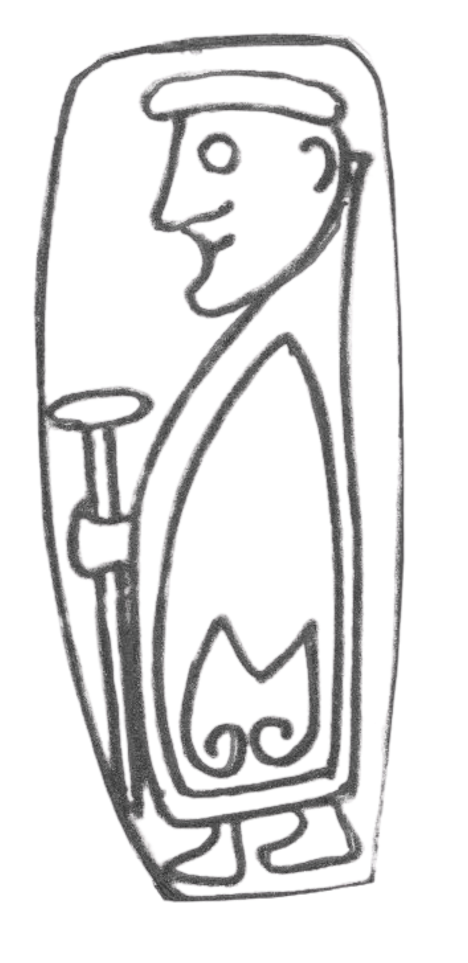
I’m thrilled. I’d only known about the inland slab-shrine at Temple Cronan, on the Burren. To see another, and along the coast, very definitely links this style of burial with Middle Eastern tradition. For very practical reasons, such as rocky ground and marauding animals, it was often inadvisable to bury bodies in the Middle Eastern desert, so slab-shrines were built instead. (Curiously, and for similar reasons, the same sort of slab-shrine is found in some old Jewish cemeteries on the Saskatchewan prairies.)
If old habitations near the sea interest me, Ryan declares I must visit Cill Rialaig. It overlooks Ballinskelligs Bay, on Bolus Head, and is now an artists’ colony. I am not so sure. Cill Rialaig supposedly means “church of the regulars”, due to its association with the Canon Regulars who made Skellig Michael their home, but from what I know of Irish religious history, ‘Canon Regulars’ dates from the Augustinian reforms of the twelfth century. The Kildreelig site is thought to be no earlier than the eighth century. Unless ‘reelig’ means relics.
But it is a bright sunny day full of scudding clouds and wind and perhaps the view will be worth the drive, even if meeting artists is not what I came to do so we set out. The narrow road quickly becomes a track with paint-daubed sheep swarming over it. Their matted fleece is overgrown which makes their legs seem rickety but given the cold weather, shearing probably won’t begin for another month. We push forward slowly, giving a nod to the old farmer following the sheep, until we come to a sign saying Park All Vehicles Here.
It quickly becomes apparent why. The deep ruts and steep drops are treacherous to negotiate, even on foot. Ryan tells me that the original little settlement clinging to the hillside dates back to 1790. Abandoned during the Great Famine, its very remoteness allowed it to survive practically untouched. Its last occupant died in the 1950s and the area was subsequently slated for major development — a Ring Road was proposed to allow easier access around the Ring of Kerry — but the land was bought for private use by a group of artists in order to protect it. In 1995, eight ruined cottages were demolished and reconstructed as studios for visiting artists and writers.
Today the retreat is deserted. If Ryan hadn’t told me otherwise, I would have believed the renovated cottages to be centuries old. I peer through the dusty windows imagining what it must be like to spend a week here as an artist. Views of the ocean. Sheep. Hiking. Wind. I wonder if anyone went mad in the past from isolation.
A kilometer or so later random piles of stones are scattered in heaps below us: the remains of the early Christian monastic site, Kildreelig or Cill Rialaig, after which the artistic centre is named. My heart leaps, Ryan looks pleased with himself, and we climb over the wall to explore. It is very definitely an ecclesiastical enclosure and includes an oratory, two inscribed stones, a commemorative cross slab, a souterrain and the remains of stone huts. To the northeast is a leacht — an outdoor altar — and another cross slab. While it is too well-established to ascribe to itinerant fourth century monks, it’s a fascinating place. Later, I confirm most archeologists date it to the eighth century, which is why it hasn’t come up on my radar screen before. Ryan and I walk from stone heap to stone heap discussing what we know of early monastic settlements.
The walk to the summit of Bolus Head is about five miles, with an ascent of 1000 feet, and involves climbing over stiles, negotiating muddy fields, crossing ditches and avoiding sheep droppings. I point out some rocks on a distant hillside glistening like shiny water, but Ryan thinks it’s the angle of the sunlight. I’m not so sure. At one point I slip on an outcrop of rock and we stop and examine my shoes. They’re fine — good, strong, waterproof, hiking boots — but the rock is wet and slick, although it hasn’t rained today. The land is seeping.
“Visitors underestimate the terrain in Ireland,” Ryan says, and I feel as if the walk has been some sort of exam. “We have small mountains, not like Europe. Or Canada.” He says the word as if Canada is a climbing Mecca. “But everything here is very uneven, and often wet because the peat holds water. You have to be sure where you put your feet.”
He’s right. I’ve never hiked on such irregular, tussocky ground, the grass in spiky clumps, and I take the lesson to heart. I have no desire to twist an ankle or worse, on my first day hiking.
For our own reasons we both relax, glad to be out in the fields. I’d expected to be mentally reassembling a raw, 4th century landscape from a civilized one, but the terrain looks as it must have done for centuries, wild and ‘authentic’ — although I’m sure there have been changes. Ryan tells me he’s more comfortable in the wild than anywhere else. He lost his job during the recession, and mountaineering and exploring the wild side of Ireland with Declan became a way to reconstruct his life. But he has no background in archeology.
From the summit our panorama includes the Skelligs, Puffin Island, a military barracks and a concrete lookout post. “From World War 1,” Ryan says, of the lookout post. “There’s a series of them up and down the coast. If time permits we’ll end up at Staigue Fort,” he says, looking at his watch.
“That’s a pretty well-excavated Iron Age fort, isn’t it?” I ask. “No secrets there.”
“Too perfectly restored,” he agrees, as if relieved I don’t bite on his offer. “There are many other forts far more ruined that I prefer. Staigue Fort even has tourist facilities.”
Tourist facilities sound like a great idea, jet-lagged as I am, although a complete anachronism for the monks I’m searching for. But I don’t say so and we agree to call it a day, each having taken the measure of the other. Ryan seems assured I can handle the terrain; I feel confident he can get me to where I want to go. He drops me off at my hotel in Portmagee with enough time to get home for tea. Weather permitting, the plan is for me to catch a boat to the Skelligs tomorrow.
Except it doesn’t happen. The next morning I chat with the Portmagee boat operators, straining to understand their English within thick Kerry accents. They speak quickly, as if chewing dark brown toffee, and say what sounds like, “Christ, the weather is desperate, isn’t it?” The verdict is clear. No one will be making the trip because an Atlantic swell has started, after several weeks of perfectly navigable weather.
“But it’s not windy!” I protest.
As far as I can understand, with a lot of ‘yerras” or “derras’ and words with “sh” sounds that I have to filter off to find the word inside, the wind will pick up as soon as we leave Portmagee harbour.
“It’s not the crossing, mind,” they say. “It’s the landing. Any boat can get there. It’s the ledge you have to jump out on.”
The sailors turn back to their work, making it very clear none of them is willing to take the risk, and I stroll along the waterfront. The struggle of those who make their living from the sea jumps out at me when I read the list of names chiselled on a memorial stone in the harbour. Some of the dates are very recent.
When I enquire at the hotel later, I learn two tourists fell off Skellig Michael and died in two separate incidents in 2009, but there have been no deaths since.
