
Caherlehillan
Ryan phones while I’m eating toast spread with the best marmalade I’ve tasted in my life. He’s talked with Declan and the two of them have decided I can easily manage both the hike to Caherlehillan and the Alpha and Omega stone at Loher. Ryan has Ordinance Survey Maps and precise locations for both. My heart lifts. Other than spending time on the Burren, Caherlehillan is one of my primary reasons for coming to Ireland. I wistfully replace the lid on the marmalade, grab my water bottle and reassemble my day pack.
We drive northeast into the hills above a tiny village called Kells — not the famous one, Ireland has at least four villages in various counties with the name Kells. The word simply means “church”. Dingle Bay lies to the north of us; to the southeast are the winding, narrow, roads that we must take. They branch in multiple directions and quickly become muddy tracks. We reverse and change directions several times, and Ryan pulls out his map and mutters that we’re very close. I stare at the hedges. Blackthorn. Just coming into flower. Primroses blooming beside the puddles.
We reverse and get stuck. I laugh; Ryan looks surprised and rocks the car backwards and forwards. I nip out and have a pee behind the blackthorn bushes, hoping it will give him a few minutes to sort things out. Around me are ragtag fields divided by scrappy hedgerows. We are definitely off the tourist route. Birds sing and I try to identify them, but they must be varieties of finch I’m not familiar with.
Ryan doesn’t want me to push — I am the middle-aged visitor from Canada who is paying him to be a guide — but I tell him this happens in snow all the time back home. Driving in icy conditions and blizzards is part of Canadian Driving Instruction 101. Mud isn’t so very different. We try putting gravel below the spinning tires, me rocking the car and Ryan pushing (tricky, because it’s a standard), and Ryan gunning the engine so the air fills with burning rubber. The birds stop singing.
“I’ll have to find the farmer,” he says glumly, and walks down the lane between puddles.
I take a drink of water and look at wildflowers. More primroses, violets, dandelions. Possibly sorrel. I eat a few dandelion leaves. Stare at the fields.
The ground rumbles and a small tractor with big tires fills the lane. Ryan is in the passenger seat, and a burly young farmer, astonished to have visitors, jumps out, connects chains and yanks us out. After a few minutes of chat — “Where you from?”, “My kids will be so pleased to see an Irish tractor, can I take your photo?” — we’re off.
Ryan’s pride takes a while to recover. Caherlehillan is only a few miles away, but there are still several Y-shaped turns and grim-faced consultations with the map before we reach yet another narrow, muddy lane and see a clump of farm buildings ahead. They seem to be abandoned, with storage sheds flapping with black baling plastic and empty feed containers. But a collection of farm dogs run out to greet us, and a red-haired, muddy-armed Irish woman — Mary — follows, wiping her hands on her apron. She’s surprised at our arrival but has a welcoming, kind manner.
“It’s the graveyard you’ve come to see? Over the wall in the field. And the Bronze Age chieftain’s fort is up in the hills. It’s a climb, mind. You’ll need good shoes.” Her face flushes with pride. Archeologists from the University of Cork excavated the site over several summers and she remains in touch with the lead archeologist, Dr. John Sheehan, who occasionally brings a group of students.
I am a bit taken aback that this major site — the earliest known Christian site in Ireland — has no signs indicating its location, and is on private land. Does that mean that permission of the homeowner is needed each time?
“Aye,” Ryan says.
“But it’s not usually a problem,” Mary adds. “Except maybe at lambing time. We don’t want visitors wandering all over.”
We begin with the river which runs below Mary’s property. It’s called Fearta, an Irish word meaning both “death” and “miracle”, and the dual meaning plays a role in my book. Whoever these early monks were, they probably followed the river up from the sea at Cahersiveen and into the hills, establishing a community, where their leader eventually died. A type of pottery known as Bii amphorae -- globular style jugs, typically used to transport olive oil or wine — has been found nearby, dating from approximately the fifth century CE. It most likely originated from the Antioch area of the Mediterranean. The hair stands up on my neck. This is as close as I’ve come to the monks I am searching for.
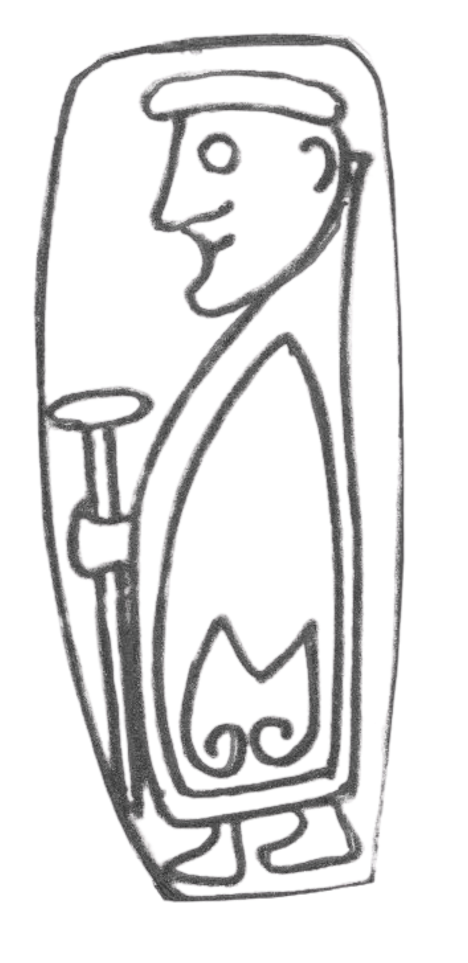
Five post holes are all that remain of the original building, but there is an “ablution drain” approximately half the length of the small church. On the east side are about eighteen gravestones scattered around at topsy turvy angles, but it is the two cross-incised stone slabs which seize my attention. They are unique in Ireland. One of them has what is considered to be a peacock carved on it, above a flabellum. Both link the carvings with Mediterranean Christianity, possibly North Africa. The flesh of the peacock was considered imperishable, which is why it was used as a symbol of the Resurrection. The flabellum was a liturgical Middle Eastern fan, usually made of palm leaves or ostrich feathers, and waved overhead to create a cooling breeze or fan away flies. It is decidedly not a native Irish artefact, and the Irish word for it, culebath or cuilefaidh is related to the word cuileag, meaning “fly”. It is astounding to find such carvings in a boggy field in Kerry.
I’m elated. Whatever its significance to the archeologist, Caherlehillan acts as confirmation for the fictional historian within me, a resounding, “Yes, this is plausible” vote of confidence for my story’s plot. I’d consulted maps, photographs and research articles before leaving Canada, but walking the terrain and looking at the peat-covered hills explains far more than any photograph. The monks would have had a rugged climb into these hills. Although nowhere near as rugged as climbing Skellig Michael.
I hadn’t known about the Bronze or Iron Age fort, but its presence isn’t unlikely as there are about fifty of them in Ireland. If the fort was still occupied when the monks arrived, it’s very plausible that permission was sought from, and granted, by the chieftain of the land. The church wouldn’t have been built otherwise. It could indicate a degree of co-operation between the two groups, which I find plausible, as monks wouldn’t have posed a war-mongering threat. Perhaps a threat as far as local resources went, but there wouldn’t have been many monks.
We spend an hour or two up at the fort. It’s windy, with wonderful views over the land all the way to Dingle Bay, and it’s easy to see why a chieftain would settle here. Ireland traded with foreign lands for centuries, exporting goods like salt, furs, iron, copper and possibly gold (although most of the gold in Ireland has now been sourced to Cornwall), and also, regrettably, slaves. In return, Irish traders obtained amber, bronze, silver, pottery, and some ivory, coral and coloured glass, wine and foodstuffs like olives and figs.
We climb down the hill and say goodbye to Mary. With her warm smile and friendly wave, she comes across as a wonderful guardian of land which has been in her family for generations. I’d love to have her as a neighbour. She and Ryan agree the outdoors is the only life and one they’d willingly live for the love of it — if it weren’t for the challenge of generating an income stream.
